“It’s going to be fun to watch and see how long the meek can keep the earth once they inherit it” -Kin Hubbard.
“The meek shall inherit the earth – if that’s okay with everybody” (Motto of the Dependent Organization of Really Meek and Timid Souls, or D.O.O.R.M.A.T). -J. Upton Dickson
“He leads the humble in what is right, teaching them his way. The LORD leads with unfailing love and faithfulness all those who keep his covenant and obey his decrees.” -Psalm 25:9-10, NLT
It’s quiet on this Monday morning, except for the sound of a rooster and a fiddle, an infant’s grunts from his swing, and a toddler’s delighted dancing as she watches – again – the Baby Einstein “Life on the Farm” video. Watching the two of them – especially with scenes from an abundant earth passing by – reminds me from the last post how we were wired from creation and birth.
We were created to inherit the earth. It’s in our DNA. But in the wisdom of God, He knew we would need help. His help. Without it, we have the capacity to do – well, what we’ve pretty much done with the planet.
That’s why Jesus – quoting Psalm 37 – said that the delighted happiness that comes from inheriting the earth is reserved for a specific kind of person. Yep – the meek.
It’s one of the secrets of everything that motivates you – in fact, your deep, abiding happiness depends on it. Yet it’s so hidden, so behind-the-scenes, that if I were to ask you to list your strongest longings, I’m almost certain this wouldn’t make the list.
But it’s there. It’s powerful. And your response to it may well be the difference between addicted and sober.
Just before I started grad school, I got a sales job with a unique premise. “Come to work for my janitorial company,” Sergio said, “and I will pay you a commission for as long as we clean the building.”
Remember that thing your mama told you about something sounding too good to be true? Yeah, that.
Living in a city the size of Fort Worth, I could easily see the potential for making some really good money for a long time. After all, the city was filled with office buildings, and that was the focus of Fort Worth Enterprises – particularly the big ones.
You can imagine how my eyes danced with dollar signs when I helped land the company’s first big account – no less than Hulen Mall. [click to continue…]
Jugglers fascinate me. Not the run-of-mill, three-balls-in-the-air type, but the ones I call the Master Jugglers. I love the guys or gals who can toss torches, chainsaws, balls and small animals all at the same time. Well, maybe not the small animals part, but you get the point.
In a sense, we’re all jugglers. Only, instead of swords or bowling pins, we juggle life. And that’s who this article is for – the jugglers. For the ones who have multiple “balls” in the air – time balls, relationship balls, money balls, even ambition balls. Every one claims to be a priority. Every one demands attention, and often wants it now. In the middle of all that, you and I have a choice: Handle them – or they will handle you.
In order to successfully juggle rather than being tossed around yourself, there are four issues you will need to settle: [click to continue…]
Today’s guest post is by Leonard Grimm. Leonard has been a deacon in three of my churches in the old days (he was stalking me), and is my favorite axe-grinder. As you can tell, he has a bit of a different idea about forgiveness. Actually, Leonard has a different idea about a lot of things.
Leonard has issues. Lots of ‘em. But in the interest of equal time and continuing the uh, discussion, here’s Leonard.
+++++++
Get a bunch of Christians and other religious people like me together, and somebody will eventually start talking about forgiving your neighbor, “seventy times seven,” and all that stuff. Well, I’m here to tell you, that’s a buncha hooey. If you’re pouting, shouting, or planning your next attack, hang in there and stay the course. Here are 10 reasons you should rethink all that forgiveness stuff:
1. It still hurts.
Just because you send the jerk on his merry way doesn’t mean his offenses don’t hurt anymore. And if you’re still hurting, why should he get off scott free? I think you need to remind his sorry soul every time you’re having a bad day.
2. It sends the message that you approve of what they did.
So the dirtbag comes along and says, “I’m sorry,” and you say, “Oh, it’s okay” with that sugar-sweet churchy voice. We all know what that means – “It’s really not that bad. I know you didn’t mean to drive drunk, cheat, steal or lie. I’ve probably done worse that.” Puh-leeze! You just signed his hall pass to do it all over again. [click to continue…]
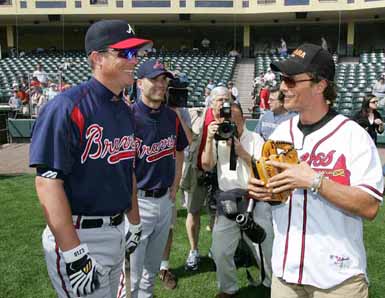
The boys of summer are back. You’ll find them hanging out in Florida and Arizona ballparks, getting those winter cobwebs cleared out, and setting out to prove they’re worth all that money (or should be paid all that money).
But while it still has to be worked out on the field, and the first word to start the proceedings is still, “Play,” make no mistake about it. The 2010 version of this game got started as soon as Mark Teixeira caught the last out of the ’09 World Series. And it was all business. That game is played by General Managers on telephones and at conference hotels and in corporate offices throughout North America and, in some cases, in island Caribbean nations or the Pacific Rim.
They were about the business of building a team. And not just for 2010.
Your payroll may be slightly less and your personnel decision may not involve as many people. But wherever you connect with others to get things done, you or somebody is building a team. And the decisions you make today can affect the quality of your team(s) for years to come.
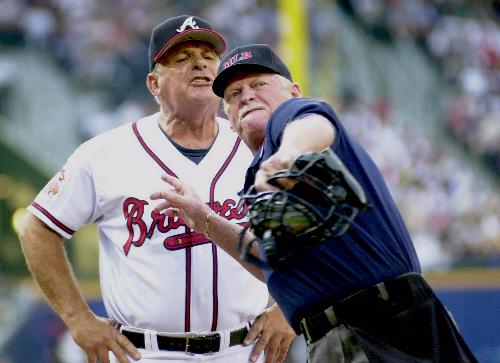
Just ask Bobby Cox, who is retiring this year after 50 years in the game. Cox has the distinction of hiring his own boss as the GM of the Atlanta Braves and “demoting” himself back to the field manager in 1991. Between him and John Schuerholz, the Braves reeled off 14 consecutive division titles – a feat unmatched in professional sports anywhere.
So what can we learn from the likes of Cox/Schuerholz, or the New York Yankees, who won their 27th World Series title last year? [click to continue…]
In the previous post I introduced you to The Law of the Nail. A corollary to the Law of the Hammer (“If all you have is a hammer, everything looks like a nail”), the Law of the Nail says,
If you are a nail, and especially if you’ve been pounded a time or two, everything (and everybody) looks like a hammer.
That’s even true when you’re a light bulb, not a hammer. Just watch the video:
Everybody gets banged up by people or by life sooner or later. But sometimes we are faced with situations in which we must work with, lead, or love people who, in nail terminology, are really bent up.
Because you are on the same planet, much less in the same building or room, they don’t trust you. Doesn’t matter whether you have earned their mistrust or not. They perceive, speak, and reason through their woundedness. And as far as they’re concerned, you’re just another hammer, waiting for your chance to pound away at them.
So what do you do with these people? Make their fears come true? Write them off? Get offended? Ignore them?
I’d like to suggest that you have an opportunity to both get the job done (whatever “the job” is) and be an instrument of healing. Here are some ideas: [click to continue…]
Ever hear of the Law of the Hammer? Also called The Law of the Instrument, it has been attributed to both Abraham Maslow and Abraham Kaplan (neither of whom were carpenters, I don’t think).
The Law of the Hammer is based on the idea that people tend to look for cure-alls or over-use familiar tools, especially in dealing with people. It says, “If all you have is a hammer, everything looks like a nail”
Wise. In other words, diversify your toolbox.
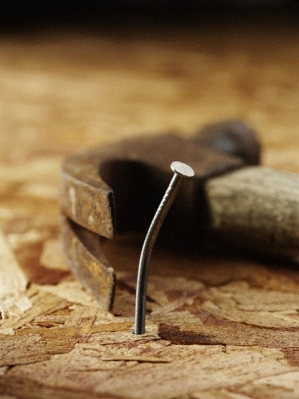
I’m not a carpenter either, and six months of bending nails in 1979-80 can attest to that. But I’ve spent a lot of my life building, working with, leading, and being an instrument of healing to people. And I have observed a corollary to the Law of the Hammer that is important to remember in dealing with people. I call it The Law of the Nail:
If you are a nail, and especially if you’ve been pounded a time or two, everything (and everybody) looks like a hammer.
I’ve been on all sides of that. I’ve been the nail. Banged the nail. Straightened out bent nails. Sat in on more than my share of Nails Anonymous meetings (including pastors’ prayer meetings). I’ve hired nails to go to work for me without realizing how pounded they had been. And I have learned, sometimes the hard way, that living in a broken world means working with and leading broken or bruised people. So at the risk of pounding the metaphor too much (sorry), here are some ideas for finding healing if you are the nail, or in the next post, working with and leading the nails in your organization or workplace. [click to continue…]
Okay this post is interactive, so get a pen and something other than your outgoing mail to write on. Or do what I did and pop up your word processor.
Here’s the challenge: Watch the 46-second video below and see if, based on that, you can think of at least one adjective that begins with each letter of the alphabet. (Confession: I had to watch about five times, but I got it.)
Why this video? Only because I saw it the other day and thought it was way-cool. Here’s the back story: A missionary had distributed Gideon Bibles to a village in Malawi, Africa. These people were so happy to get their hands on their own Bibles, they spontaneously broke out into song and dancing, worshipping God in gratitude. (When was the last time you did that when you got a new Bible?)
So click on the “play” button and start listing adjectives. See how many plays it takes for you to get a full list. I’ll show you my list after it’s over and you have yours.
In the last post I shared some ideas based on the experience of a prophet in the Bible named Elijah about what to do when we try to draw from familiar sources of support, provision (income), encouragement, or direction – only to find that they simply aren’t there anymore. In the two days since then, I have talked to
a man who needed counsel and didn’t have a pastor,
a missionary who has seen a significant decrease in support,
a former lay leader in churches who is struggling to find a church home,
a pastor whose congregation is struggling both financially and in attendance,
a student whose marriage engagement has broken off,
a church member in another city whose pastor was terminated, then abruptly died.
What they all have in common – in the language of Elijah’s experience, their “brooks have dried up.”
I fully expect that nearly half the conversations I have tomorrow will be in the same vein.
 “It’s going to be fun to watch and see how long the meek can keep the earth once they inherit it” -Kin Hubbard.